The study maps where Apexon’s AI-driven engineering sits against 45 other providers.
Analyst Recognition
Apexon named a Leader in all three quadrants of the ISG Provider LensTM 2026 Digital Engineering Services study

Why this recognition matters
Recognized in a market defined by agentic AI and the end of intelligence debt
The ISG Provider LensTM is an independent, quadrant-based evaluation of providers’ real-world capabilities. Its 2026 Digital Engineering Services study assessed 46 midsize providers in the U.S. against a clear thesis: the market is moving past isolated AI pilots toward agentic, self-healing systems that unify R&D, operations, and customer experience into a single AI-led digital thread.
ISG describes the central challenge of 2026 as eliminating “intelligence debt” – the value trapped in siloed, disconnected data. Apexon was named a Leader across all three quadrants for doing exactly that: applying AI-native engineering to dissolve those silos and turn data into autonomous, measurable outcomes.
Three quadrants. One AI-native engineering model.
Where Apexon leads in the ISG Provider LensTM quadrants
Three evaluations, three Leader placements. Step through each quadrant to see where Apexon sits – and what put it there.
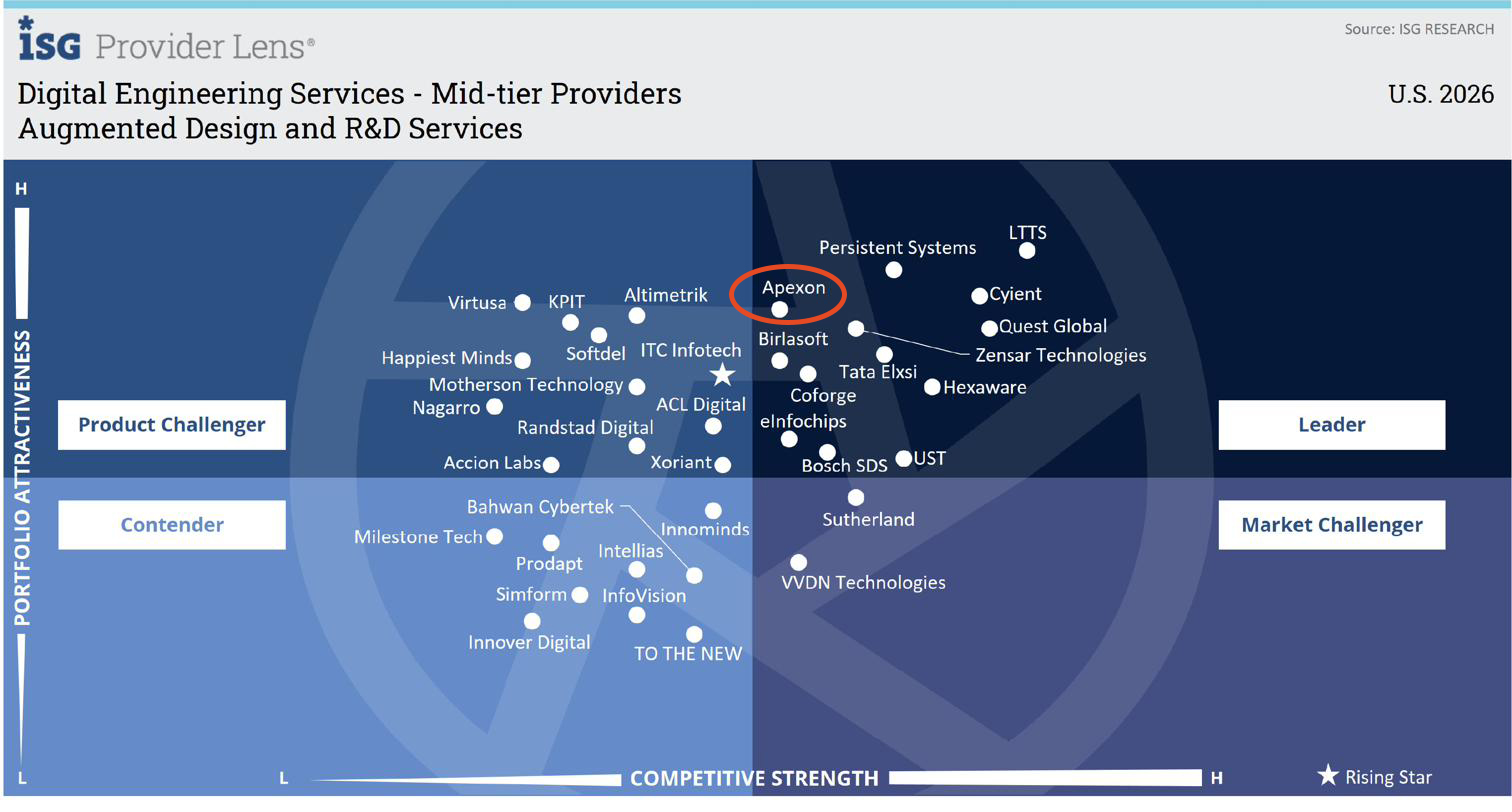
Augmented Design & R&D Services
“Apexon delivers pace, predictability and performance across complex R&D cycles.”
- GenAI-accelerated engineering velocity via PlatformAlphaTM & TransformAlphaTM – automating blueprints, test scripts, documentation.
- XR prototyping with digital twins to stress-test products virtually before physical build.
- Rapid AI-centric experimentation through Apexon Labs, a co-innovation sandbox.
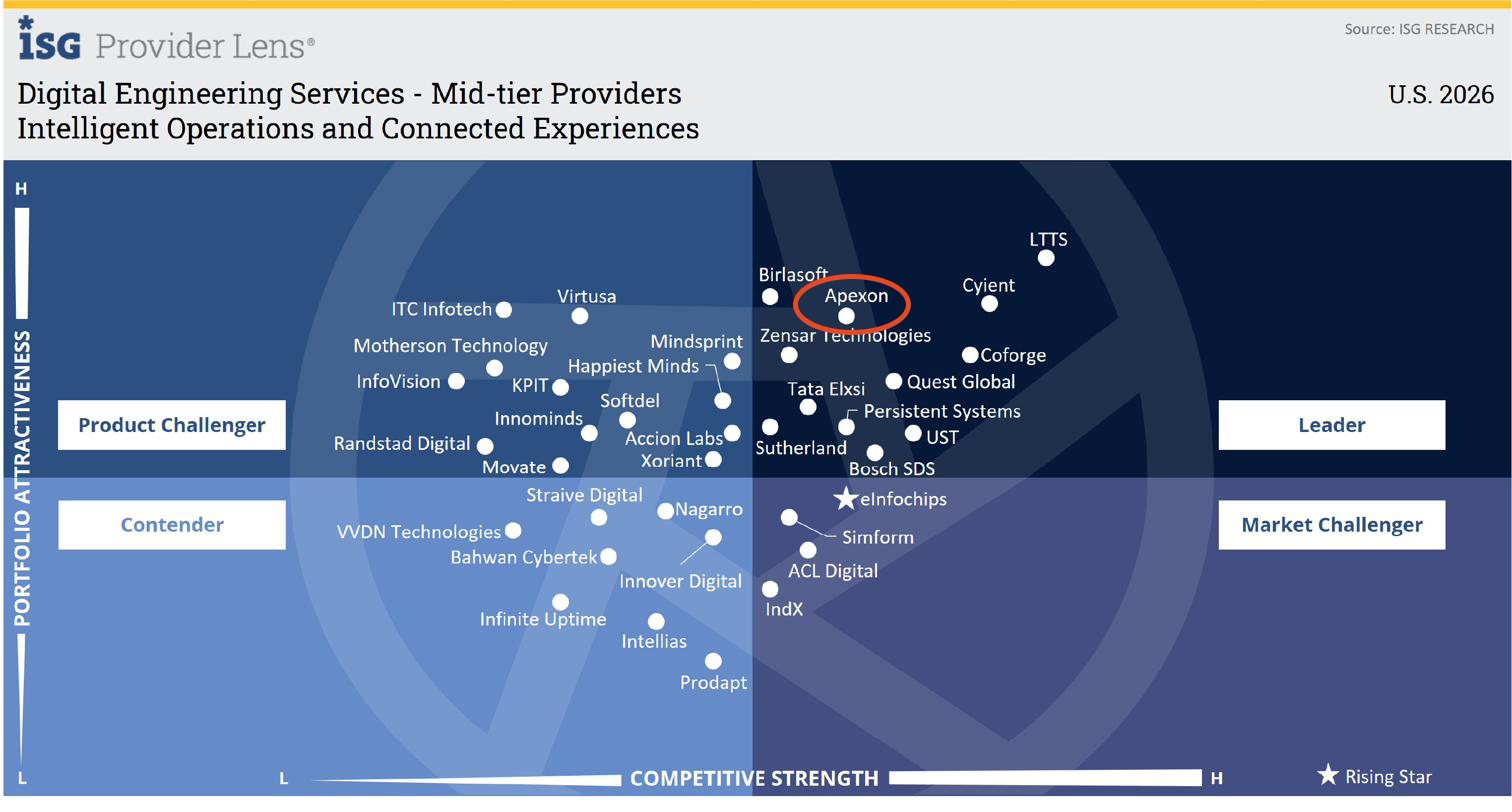
Intelligent Operations & Connected Experiences
“A strong choice for enterprises converting operational data into personalized, real-time engagement.”
- Agentic AI for self-healing operations via AgentRiseTM – context-aware agents that autonomously execute multi-step workflows.
- Intelligent automation through the D4 framework (Discover, Design, Develop, Deliver).
- Omnichannel CX personalization at scale via the Experience Assurance & Insights platform.
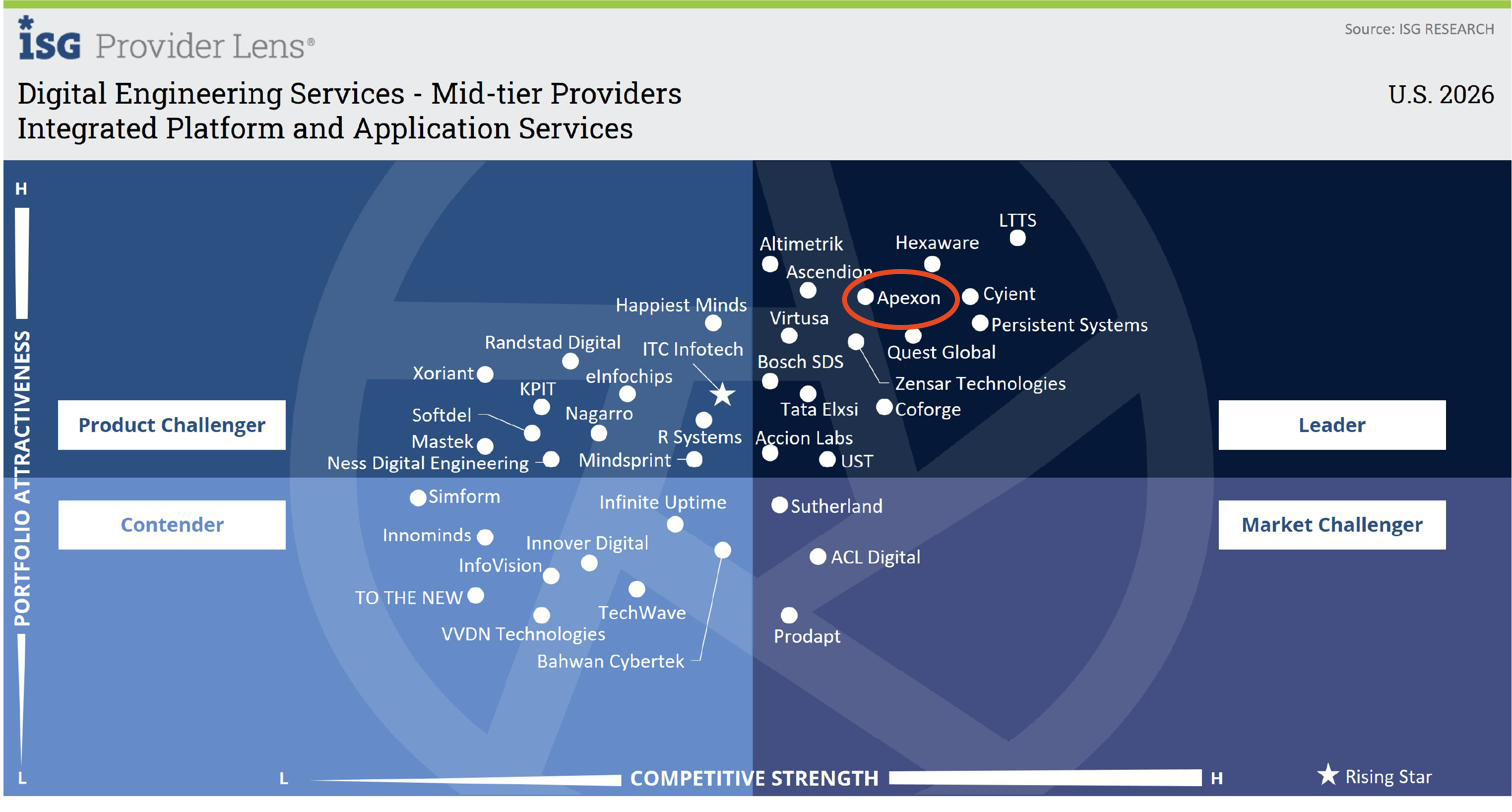
Integrated Platform & Application Services
“Strong GenAI-enabled application services and an agile-led approach to mainframe and cloud modernization.”
- AI-enabled legacy modernization via TransformAlphaTM – refactoring mainframe code into AI-ready microservices.
- Unified Cloud Canvas with embedded SRE and FinOps-driven multi-cloud scaling.
- Highly compliant platforms for regulated industries (SaMD, banking) via Assure 360.
Analyst Speak
“Apexon demonstrates a strong mid-market digital engineering proposition, combining product engineering, cloud-native development, data modernization, AI-led automation, and experience-led delivery. Its capability is anchored in accelerating digital product outcomes, modernizing enterprise platforms, and enabling scalable engineering execution through agile methods, domain alignment, and measurable business value.”

Shirish Kulkarni
Senior Lead Analyst, ISG Provider LensTM
Senior Lead Analyst, ISG Provider LensTM

AI-native Engineering
This recognition runs on our AI-SDLC
Apexon doesn’t bolt AI tools onto existing teams – we redesign the software development lifecycle itself around agentic AI. Our AI-SDLC embeds intelligent agents across planning, coding, testing, review, deployment, and operations, attacking the real bottleneck in modern engineering: decision latency, the lag between a commit and production, a requirement and its test, a defect and its fix.
The model rests on spec-driven development, context and harness engineering, knowledge compounding, and automated quality gates – so quality is enforced, not inspected, and governance is auditable by design. Engineers shift from writing every line to becoming agent managers: they set intent, govern constraints, and compound institutional knowledge while agents execute, test, and deliver. Early adopters are seeing 3–4x developer output without adding headcount.
That is the AI-native engineering model ISG recognized across all three quadrants – and it’s how we move clients from AI pilots to a self-optimizing, harnessed engineering operating model.
Apexon doesn’t bolt AI tools onto existing teams – we redesign the software development lifecycle itself around agentic AI. Our AI-SDLC embeds intelligent agents across planning, coding, testing, review, deployment, and operations, attacking the real bottleneck in modern engineering: decision latency, the lag between a commit and production, a requirement and its test, a defect and its fix.